How we the
Childcare


Our core principles
Our fundamental attitude is to accept every person as they are. Every child is accepted, valued and respected with their individual abilities and needs, and has the right to live, play and learn in the community. You can find a detailed elaboration of our overall concept in our Concept.
InclusionLearn more about inclusion
„It's normal to be different.“
All children have particular strengths and weaknesses due to specific developmental trajectories. Depending on their individual characteristics, they require tailored support and differentiated learning goals.
For over 45 years, the inclusion of children with disabilities into the community has been a crucial concern for us. We place great emphasis on shared development within the community, taking into account the individual circumstances and needs of each child.
Children with intellectual, emotional, and/or physical impairments contribute significantly to the enrichment of social learning within the group and are, in turn, strongly supported by the group. Through play, all children learn to interact with each other without prejudice. Similarities are brought to the fore and differences are acknowledged.
Educational and special educational support is provided within the overall group or in small groups. A personal assistant can be assigned to the child with special needs, who also acts as a point of contact for all other children. Where appropriate, individual support is also possible.
With this work in our kindergarten, we see ourselves as a building block for the goal of an inclusive society.
Montessori educationLearn more about Montessori education
The educational work is based on reform pedagogy and special needs pedagogy principles, particularly Maria Montessori's pedagogy. Through the principle of the prepared environment, with its special didactic materials that take into account the learning needs of the child's sensitive phases, children are encouraged towards independent and responsible action. Respect for the individual personality and the free development of a child's creative gifts are given special importance in our institution.
„Help me to do it myself.“
This saying from a child became Maria Montessori's, the founder of reform pedagogy, guiding principle.
Maria Montessori developed a wide range of materials and divided them into different areas. These include exercises of daily life, sensory materials, and materials for language, mathematics, and the cosmic education. Each material has a high incentive character and encourages children to act independently. All materials can be used at different levels of difficulty and give the child the opportunity for self-correction.
The prepared environment is an important pillar in Montessori education.
The structuring of space and the arrangement of materials is a central task for the educator. Each material is present only once and has its fixed place. This offers children orientation and security and encourages them to act independently. These external principles of structure and order help the child to achieve inner order.
The materials are kept on open shelves, at the children's eye level and within their reach, and are freely accessible. We carefully maintain the materials, continuously expand them, and adapt them to the requirements of the present day as well as the individual needs of the children.
The child is introduced to the materials individually or in small groups by the educator. The presentation is done using the three-stage lesson, after which the children are able to recognise and name the objects themselves. In this way, properties of the materials such as colour, shape, size, weight, and sound are demonstrated.
During free play, children have the opportunity to repeat exercises. The child is given space to have their own experiences, correct mistakes, and apply what they have learned in other areas.
Preparing for school and lifeFind out more about preparation
Preparation begins at birth. For a child to develop a stable foundation for life, they require a diverse range of skills. These are best fostered and expanded through collaboration between families and educators („educational partnership“, see parental involvement).
Our task as educators is to stimulate and support the child in a way that is appropriate for their development. A key role is played by the connection between play and learning, and learning with all the senses. Montessori materials, as concrete experiential materials, are particularly suitable for acquiring diverse abilities, skills, preschool basic competencies, and well-founded knowledge and expertise.
The child is introduced to the materials individually or in small groups by the educator (e.g., using the three-period lesson). During free play, the child repeats their self-chosen exercise and perfects their actions. The child is given space to gain their own experiences, as well as time to become independent. The education for independence through self-activity is therefore paramount.
The aim is to prepare the child for lifelong learning and responsible action in social contexts, fostering enjoyment and curiosity, perseverance and trust, self-reliance, and social sensitivity (community spirit).

Kindergarten group
Approx. 3 years until school entry
up to 19 children
3-5 Children with special educational needs
Small groupFind out more about the mini-group
The mini-group takes place every Monday from 3 pm to 5 pm in the kindergarten premises for children aged approximately 2 years and above. The inclusive concept is also reflected here, offering a space for children with and without special educational needs. The focus is on playing and discovering together. Through free play and guided activities, the children get to know each other, sing songs, hear stories, and gain initial experience with Montessori materials. The mini-group does not take place during school holidays and on public holidays.
Registrations are possible by appointment. Simply get in touch via our contact form or at:
Tel: 0921 – 57938
Daily routine
Maternity leave
The parents say goodbye to their child and take them to the group room. We place importance on greeting each child personally in the morning.
Leisure game
The child's own actions are at the forefront. The children choose their activities according to their individual needs and interests. They make contact with their playmates and learn to engage with them.
Morning circle & snack time
Daily ritual of counting children, discussing the date and weather, and a shared circle game.
Afterwards, we will meet at a long table. Singing, praying and eating together.
Learning arrangements
For the groups, there is, for example, weekly gymnastics and the presentation and introduction of Montessori materials, experiencing music, dance and rhythmics, reading aloud and listening to stories and fairy tales, table theatre or working on various projects, experimenting, researching, and much more.
Out we go
From around 12:00 PM, we go into our large garden daily and in all weathers. The children play in the fresh air. The children can be picked up by 1:00 PM.
On Tuesdays, Wednesdays and Thursdays, we offer a warm, child-friendly lunch for registered children at 1:00 PM.
Collection time
Collection of all children. For our staff, preparation and winding-down time begins.
Care hours
Opening hours
Drop-off & Pick-up
Closing times
The 30 statutory days of closure in the kindergarten year are based on the Christmas, Easter, and summer holidays and are announced to parents in September for the following kindergarten year.
Rules, rhythm, rituals
Rules, rhythm and rituals shape daily kindergarten life and foster a sense of community. Adhering to rules, recognising daily, weekly and annual rhythms, and recurring rituals give children inner peace, security and a sense of belonging. Children develop an awareness that we are part of a whole, both as individuals and as a community.
Each kindergarten year has a specific theme. This theme accompanies the children through the kindergarten year with diverse projects. It allows for in-depth exploration of various focal points from nature, the environment, and society. A wide range of educational content, tailored to the interests and needs of the children, is conveyed holistically and in an experience-oriented manner.
For each annual theme, the children create their own folder, which they take home at the end of the year.



Nutrition

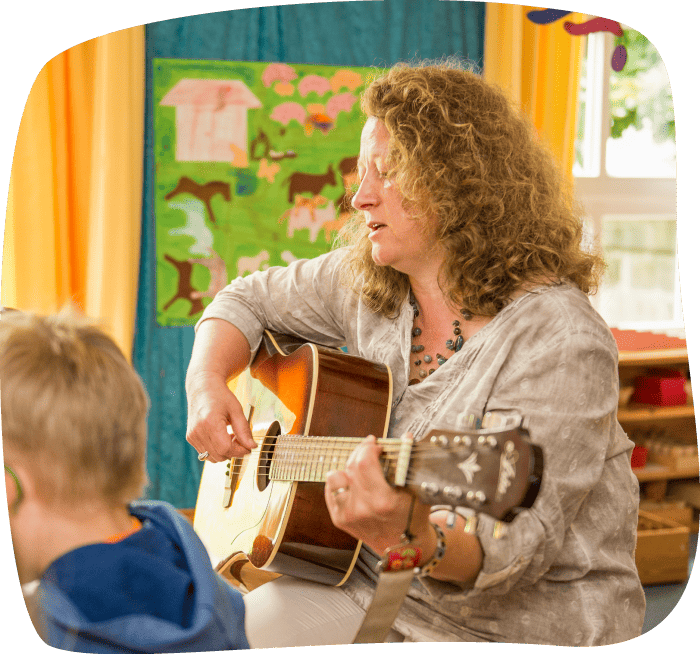
The healthy diet of children is of particular concern to us. From the outset, they are involved in the preparation of fresh and healthy foods. In a playful way, they are taught which foods are good for the body and our well-being.
Every Friday, we prepare our „healthy breakfast“ together. The selection ranges from homemade rolls to fruits and raw vegetables, various salads, smoothies, and much more. On the other days, parents ensure that the children have a balanced packed lunch.
During snack time, just like at lunch, we all sit together at the table. We value a calm atmosphere and teach the children our table manners.
Our lunch is prepared fresh on the premises. We focus on seasonal and regional products, preferably organic. The meal always consists of a fruit and vegetable platter, a main course, and a dessert. Where possible, the children's wishes regarding the menu are taken into account. After all, healthy food should taste good and be fun!
We participate in the EU School Fruit Scheme and source our food from Hutzelhof, a supplier of organic fruit and vegetables.
Movement
and thus an essential factor in building intelligence.“
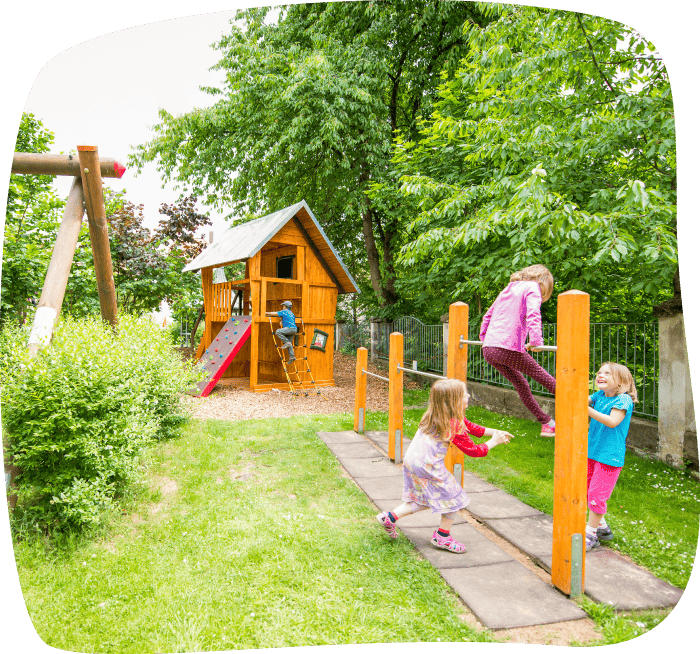
All children naturally have a great need for physical activity. In doing so, they not only learn a wide range of motor skills and abilities, but also develop a good sense of their bodies. They recognise their own limits and gain confidence and self-assurance. Scientific studies show that movement is closely linked to learning. It promotes brain development through the networking of nerve cells and the formation of synapses, which are necessary for the development of intelligence.
The inclusion of motor skills is a fundamental aspect of Montessori education. Working with Montessori materials enables the child's physical activity to be incorporated. All exercises are linked to movements and appeal to the child's muscle memory. A variety of movement and balance exercises, such as walking on a line, support conscious movement coordination.
Children's opportunities for daily movement have drastically reduced for some time now. It is therefore important for us to offer children varied and diverse opportunities for movement every day.
Parental involvement
We see ourselves as an establishment that complements and supports the family, fostering the child's development individually and holistically in conjunction with the parents. Regular communication with the child's family and transparency in our educational work are therefore very important to us.
Education and training partnerFind out more
For the educational partnership, it is important to us that parents and the nursery team pursue the same goals and accept and respect each other. We see parents as the experts on their child and assume that they take their responsibility towards their child seriously. The well-being and development of the child are at the centre of the collaborative partnership.
Additionally, we see the active support of parents as beneficial to the success of our pedagogical work and are delighted that parents are actively involved in shaping the kindergarten's work.
For our children, everyone pitches in: be it a supportive contribution to the buffet at our festivities, the renewal of the play sand in the garden, or always clean towels for every child.
To foster the lively togetherness of all kindergarten families, an annual family outing takes place. All kindergarten children, along with their parents, siblings, and the kindergarten team, spend a weekend together at a nearby holiday home.
Through various excursions, activities and games under a specific theme, we strengthen togetherness and support team spirit.
Parental serviceFind out more
There is the possibility for parents to accompany their child in the kindergarten's daily routine for a week or individual days as part of a parent service.
Parent and development consultationsFind out more
Once per kindergarten year, a development discussion takes place for each child. In addition, there are often „doorstep conversations“ between the team and the parents. If necessary and requested by the parents, we are open to further discussions.
For children with increased support needs, developmental consultations take place twice a year in collaboration with the kindergarten team, parents, and the respective therapists. During these consultations, the child's current developmental status is determined, and short- and long-term goals for further development are jointly set.
Parents' eveningFind out more
The parents, the kindergarten team and the provider representative meet for a parents' evening every 8 to 12 weeks.
The evening will be hosted and conducted by a parental couple. Preparations for this will be made together with the team.
The parent evenings serve for joint reflection, planning and preparation of upcoming activities, setting dates and dealing with pedagogical topics.
External speakers are also invited as needed and required, or the kindergarten team presents focal points of their pedagogical work.